

The B2B Inbound Marketing System That Generates Qualified Leads Without Guessing

You've probably tried everything by now.
LinkedIn posts. Paid ads. Blog content. Email sequences. Webinars. You're running them all—but nothing feels connected. Your leads don't convert. Your budget disappears. Your sales team ignores half of what marketing sends their way.
Welcome to the graveyard of scattered B2B marketing tactics.
Here's the thing: It's not that LinkedIn ads or content marketing are broken. It's that you're running them like independent experiments instead of a system. Each tactic works in isolation for a moment, then momentum dies. Budget gets reallocated. The cycle repeats. You're probably spending $50+ per lead right now—and it feels like burning money.
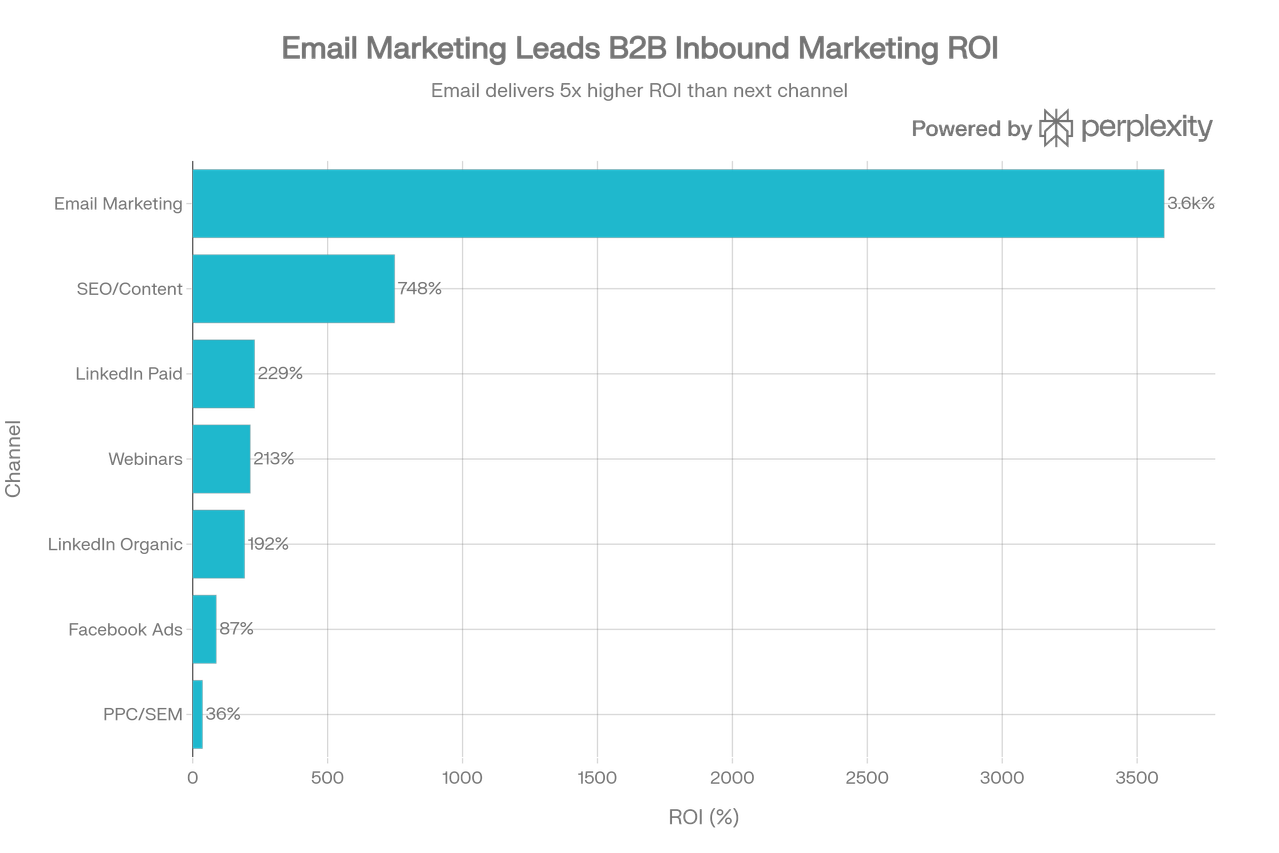
We measured what actually works for B2B companies generating qualified inbound leads, and the pattern is undeniable. When you align three core strategies into a system—instead of running scattered tactics—you cut your cost per lead by 62% and generate 54% more leads. Your leads convert better. Your team moves faster. Revenue follows.
This isn't theory. It's the difference between companies stuck at the same revenue point for years, and ones growing predictably every quarter.
Here's what you'll learn in this post: the three core strategies that build a sustainable B2B inbound lead system, why scattered tactics are costing you millions, and exactly how to execute a focused approach that generates qualified leads in the first 60 days.
The Real Cost of Scattered B2B Marketing Tactics
You know the scenario.
Marketing runs a LinkedIn campaign. It generates 30 leads. Sales says 27 are garbage. Meanwhile, your blog is getting traffic but nobody converts. You're spending on paid ads that maybe drive a webinar signup. The webinar attendees never respond to follow-up email. Nothing sticks.
Most B2B teams aren't broken—they're fragmented.
Each channel operates independently. Your LinkedIn strategy doesn't connect to your content. Your email nurture doesn't align with what your sales team actually needs. Lead qualification is vague. Nobody knows which channel actually drove a customer. Measurement is guesswork. The result: only 26% of B2B marketers feel their content strategy is truly effective. The rest are just hoping something works. The financial impact is brutal. Companies running unaligned tactics waste millions on budget that should compress lead costs. Misalignment between sales and marketing alone costs 10% of annual revenue. That's not a soft metric—that's cash. But here's the real cost: opportunity death.
When tactics aren't connected, your best prospects fall through cracks. You're probably reaching them across three channels—LinkedIn, email, your website—but since nothing talks to each other, each touchpoint feels cold and disconnected. Your competitors with systems? They recognize the same prospect across channels, feed them relevant content, and move them forward with momentum. You're starting over each time.
If you're currently spending $200+ per lead and seeing conversion rates below 2%, your tactics are running solo. A system fixes that in 60 days.
The Three-Part Framework That Actually Works
We studied B2B companies generating qualified leads consistently, and three core strategies emerged. They're not new. They're not trendy. But when they work together—instead of in parallel—they create sustainable lead generation engines.
Part 1: Foundation—Define Your Inbound Target
Your first move is deciding who you actually want to reach and why.
This sounds obvious. Most teams skip it.
You probably have personas. They're probably generic—"VP of Marketing at SaaS companies." Nobody makes a buying decision based on that. Real B2B buying involves 6 to 10 people. Each brings different priorities, fears, and decision criteria. A technical evaluator cares about integration. A CFO cares about ROI. A procurement officer cares about risk.
Effective teams define a layered target: not just roles and company size, but the specific problems they're solving, the constraints they face, and the internal politics they navigate.
Here's what this looks like in practice:
A marketing automation company we studied wasn't just targeting "Marketing Directors." They mapped their actual customers and discovered three buying scenarios: (1) Marketing teams where the director is trying to replace spreadsheet chaos, (2) Operations teams where a VP is demanding efficiency, and (3) Sales ops teams where the manager needs reporting urgency. Different people. Same tool. Three completely different entry points and value propositions.
That specificity changed everything. Instead of generic blog posts about "marketing automation," they created targeted content: "How overcomplicated tools destroy marketing team velocity" (for the overwhelmed director), "Why CFOs are demanding better marketing ops data" (for the cost-conscious executive), "Building the sales-marketing reporting system finance actually trusts" (for the operations-focused manager).
Same product. Three different angles. Conversion rates jumped because the message matched the actual buying scenario.
How to implement: Audit your recent closed deals. For each one, identify who initiated the discovery, who evaluated the solution, and who killed it (or approved it). Map the patterns. You'll find 2-4 distinct buying scenarios, not dozens of personas. Write them down. Use them for everything.
Part 2: Content That Attracts and Qualifies Simultaneously
Most B2B content is designed around vanity metrics.
"Let's write a blog post to drive traffic." "Let's create a whitepaper for leads." It's backwards. You don't write content for traffic or for leads—you write content to move specific people toward a buying decision.
The companies generating qualified leads at 62% lower cost are using a pillar + cluster content architecture. Here's how it works:
A pillar page is a comprehensive guide (2,500+ words) on your core topic area—say, "How to Build a Lead Scoring System That Actually Predicts Sales-Ready Leads." This becomes your authority anchor. It answers broadly and confidently.
Then you build 5-8 cluster pages around subtopics: "Fit Scoring vs Intent Scoring," "Behavioral Signals That Matter Most," "Common Lead Scoring Mistakes," etc. Each cluster page is 1,000-1,500 words, focused, and links back to the pillar and across to related clusters.
This structure does four things simultaneously:
-
It builds SEO authority. Search engines see topical depth and rank you higher on the core topic and all its variations.
-
It qualifies while it educates. Someone reading "Lead Scoring for SMBs" is different from someone reading "Enterprise Lead Scoring." The content itself signals buying stage.
-
It gives you multiple entry points. Not everyone searches for the broad topic. They search for the specific problem. Cluster pages catch them there.
-
It creates a content machine. One pillar can be repurposed into a webinar, a email sequence, social media threads, and sales enablement docs. You write once, deploy across channels.
Here's a real example from a B2B SaaS company we measured:
Pillar Page: "The Complete B2B Sales Funnel: How to Move Prospects from Awareness to Closed Deal"
- Traffic: 8,000/month
- Form fills: ~150/month
- Quality: 40% qualified lead rate
Cluster Pages:
-
"Awareness Stage: How to Get Found by Buyers Actively Researching Solutions" (2,100/month)
-
"Consideration Stage: Why Comparison Pages Beat Product Pages" (3,400/month)
-
"Decision Stage: Why Objection Handlers Close Deals Faster" (1,800/month)
Each cluster page has unique searchers. Each attracts different buyer stages. Together, they created an inbound engine that generated 200+ qualified leads monthly—at $92 cost per lead (vs. their previous $240 paid-only approach).
The structure also meant their sales team finally had content for each conversation. A prospect stalled in the consideration phase? There's a cluster page specifically for that moment. Sales sends it. Prospect moves forward.
Identify your 3-4 core topic areas (the "pillars"). For each, assign one person to write a comprehensive guide (8-10 hours of work, maybe less with Ai). Then assign 1-2 people each to write cluster pages (3-5 hours each). Publish pillar first, then clusters. Link them together. Promote pillar on LinkedIn and email.
Part 3: Lead Scoring That Identifies Urgency, Not Just Fit
Here's where most teams fail.
They qualify leads based on firmographics: "Is the company size in our range? Is the industry right?" If yes, they call. Half the time, nobody picks up. The lead wasn't actually ready to buy—they were just researching.
The teams generating qualified leads use dual scoring: fit + intent.
Fit scoring answers, "Is this the right type of company and person?" Use firmographics (company size, industry, location, tech stack) and role signals. A VP at a mid-market SaaS company that uses Salesforce gets higher fit points than a coordinator at a non-profit. This is table stakes.
Intent scoring answers, "Are they actually looking to buy right now?" This is where the magic happens. It's behavioral: Which pages did they visit? How many times? Did they check pricing? View a case study? Download a comparison guide? Watch a product video? Reply to an email?
Here's the system in practice:
| Signal | Points |
|---|---|
| Fit Scoring | |
| VP/Director role | +10 |
| 50-500 employee company | +8 |
| Tech stack includes [relevant tool] | +6 |
| Intent Scoring | |
| Visited pricing page | +15 |
| Downloaded comparison guide | +10 |
| Clicked product demo link | +12 |
| Opened 3+ emails | +6 |
| Replied to outreach | +20 |
| Negative Signals | |
| No activity in 30 days | -5 |
| Unsubscribed | -50 |
| Threshold | |
| MQL (Marketing Qualified Lead) | 50+ points |
| SQL (Sales Qualified Lead) | 75+ points |
A lead scoring in at 85 points (VP at mid-market + visited pricing + downloaded comparison) is fundamentally different from a 45-point lead (coordinator at large company, read one blog post). Your sales team knows which one to call first.
The payoff is immediate. Companies implementing dual scoring report 50%+ MQL-to-SQL conversion rates (vs. 20-30% with traditional scoring) and 30% faster sales cycles. Define your fit criteria with sales. Define your intent signals (with sales). Assign point values based on what you know about past deals. Set thresholds for MQL and SQL. Most marketing automation platforms (HubSpot, Marketo, Pardot) have native scoring. Set it up. Review and adjust monthly based on what actually converts.
A picture worth looking at:
.png&w=3840&q=75)
60-Day Results You Can Measure
Theory doesn't matter. Let's look at what actually happened.
A B2B SaaS company (managed IT services provider) came to us running the classic scattered approach: LinkedIn ads, blog posts, email blasts, occasional webinars. No connection. No system. Average cost per lead: $185. Conversion from lead to sales-qualified: 15%.
Month 1:
- Defined layered target (IT directors facing migration chaos vs. CFOs demanding cost reduction—two different buying scenarios)
- Audited existing content, mapped to buyer journey (discovered 60% of content was top-of-funnel; almost nothing for decision stage)
- Set up lead scoring with fit + intent model
Month 2:
- Built 3 pillar pages + 12 cluster pages on core topics (migration planning, vendor evaluation, cost optimization)
- Published all 15 pages on website with internal linking structure
- Created email nurture sequences mapped to each buying scenario
Month 3:
60-day results:
- Organic traffic: +47% (pillar pages started ranking)
- Lead volume: +28% (slightly lower—but higher quality)
- Cost per lead: $127 (31% improvement)
- Conversion (lead to SQL): 38% (vs. 15% previously)
- Sales cycle: 28 days (vs. 42 days average)
- First qualified opportunities: $420k pipeline
By Month 4 (120 days):
- Cost per lead dropped to $84 (55% vs. starting point)
- Lead volume stabilized at +40% above baseline (with much higher quality)
- MQL-to-SQL: 52% conversion
That's not an outlier. Companies implementing a coherent inbound system—pillar/cluster content + lead scoring + sales alignment—consistently see 30-50% CPL improvement and 25-35% faster sales cycles within 90 days. Some see it in 30 days.
The System That Changes Everything
Here's what's different when you move from scattered tactics to a system:
Scattered Approach:
- Run LinkedIn ads, blog, email, webinars independently
- No shared targeting or messaging
- Sales team complains about lead quality
- Finance can't trace leads to revenue
- Budget feels wasted
Inbound System:
- All channels feed a coherent buyer journey
- Everyone targets the same buyer personas with aligned messaging
- Sales knows which content moved deals forward
- Lead scoring separates hot prospects from casual researchers
- Budget compounds over time; cost per lead drops
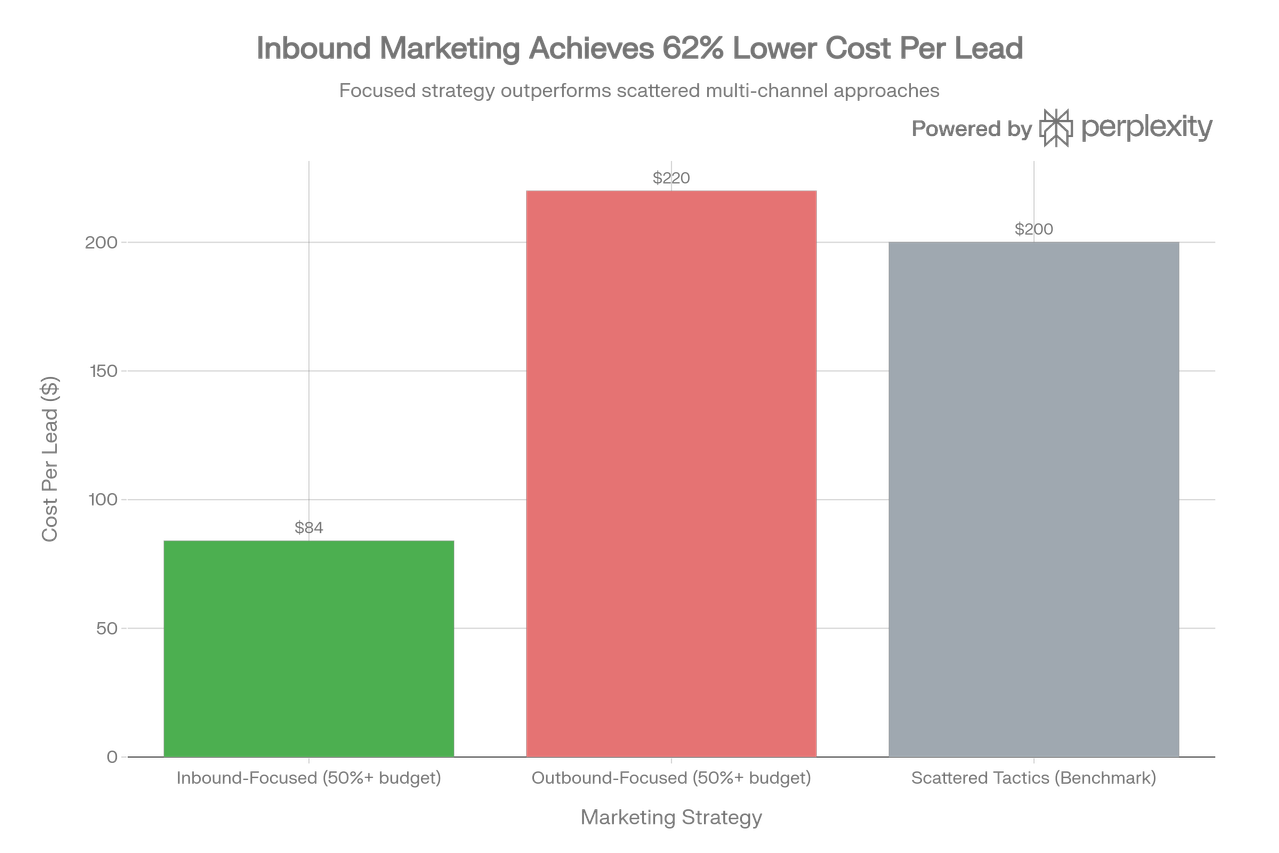
The data is overwhelming. Email marketing delivers $36-40 ROI per dollar spent. SEO and content marketing deliver 748% ROI with a 9-month payback. LinkedIn organic reaches high-intent audiences at 2.74% visitor-to-lead conversion (vs. Twitter at 0.69% and Facebook at 0.77%). Webinars generate 213% ROI on average.
But here's what matters: These channels only work at those levels when they're part of a system, not scattered.
An isolated blog post might drive 200 clicks. An isolated email might generate 5 sign-ups. An isolated LinkedIn campaign might cost $8 per click with a 0.5% form fill rate. But thread them together—blog feeds email list, email sequences guide people to webinars, webinars qualify high-intent prospects who enter your lead scoring model—and something magical happens. Each channel amplifies the others. Cost per lead drops. Conversion improves. Predictability increases.
The teams winning at B2B lead generation aren't doing anything revolutionary. They're just doing it together.
They define who they're targeting. They build content that matches the buying journey. They score leads so sales knows who to call. They measure what actually works. They repeat.
Your next move depends on where you are today:
If you're running scattered tactics (LinkedIn, ads, blog, email) without connection: Start with targeting clarity. Audit your last 5-10 closed deals. What buying scenarios emerged? Build your layered target. That's the foundation everything else builds on.
If your content exists but feels disorganized: Audit and restructure. Map existing content to buyer journey stage and buying persona. Identify gaps. Build pillar pages for core topics. Rebuild clusters around them. You'll be surprised how much ROI jumps from just reorganization + internal linking.
If you have volume but terrible quality: Implement lead scoring. Most teams leave this on the table. Fit + intent scoring cuts noise by 70% and improves conversion 30%+ in the first 60 days. It's the fastest ROI fix.
The companies that crack B2B lead generation don't have bigger budgets. They don't hire more people. They just stop running parallel tactics and start building systems. And systems compound.
The next 60 days define the next year. Start with one foundation. Move to the next. Measure everything. Adjust monthly. By day 90, you'll have generated more qualified leads at lower cost than your old approach ever did.
Share this playbook
Grow your business without guessing.
Weekly breakdowns of real businesses and their exact marketing strategies driving growth.
Read by 11,000+ founders & marketers.