
Postbridge Marketing Strategy: 0 to $18K MRR

$18K
Revenue/mo
Business Type
SaaS
Monetization
Subscription
Founded
2024
Introduction
When Jack Friks launched Postbridge in October 2024, he wasn't trying to disrupt a billion-dollar industry. He was just frustrated.
Every single day, Jack found himself sitting at his computer, manually copying and pasting the same content across Twitter, Instagram, TikTok, LinkedIn, and Facebook. It was eating up an hour of his time—time he needed to actually build his apps and make money. The "solution" from the big guys? Buffer wanted $20/month. Sprout Social wanted $100+. And all of them made you feel like you needed an engineering degree just to schedule a post.
So Jack built his own tool. Just him. No investors. No big team. No fancy marketing budget.
By February 2025, just four months later, he had hit $6,000 in monthly recurring revenue. By January 2026, that number had climbed to somewhere between $14,000–$18,000/month in recurring revenue.
That's a business doing approximately $210,000 in annual revenue—built by one person, with zero paid ads, in just a few months.
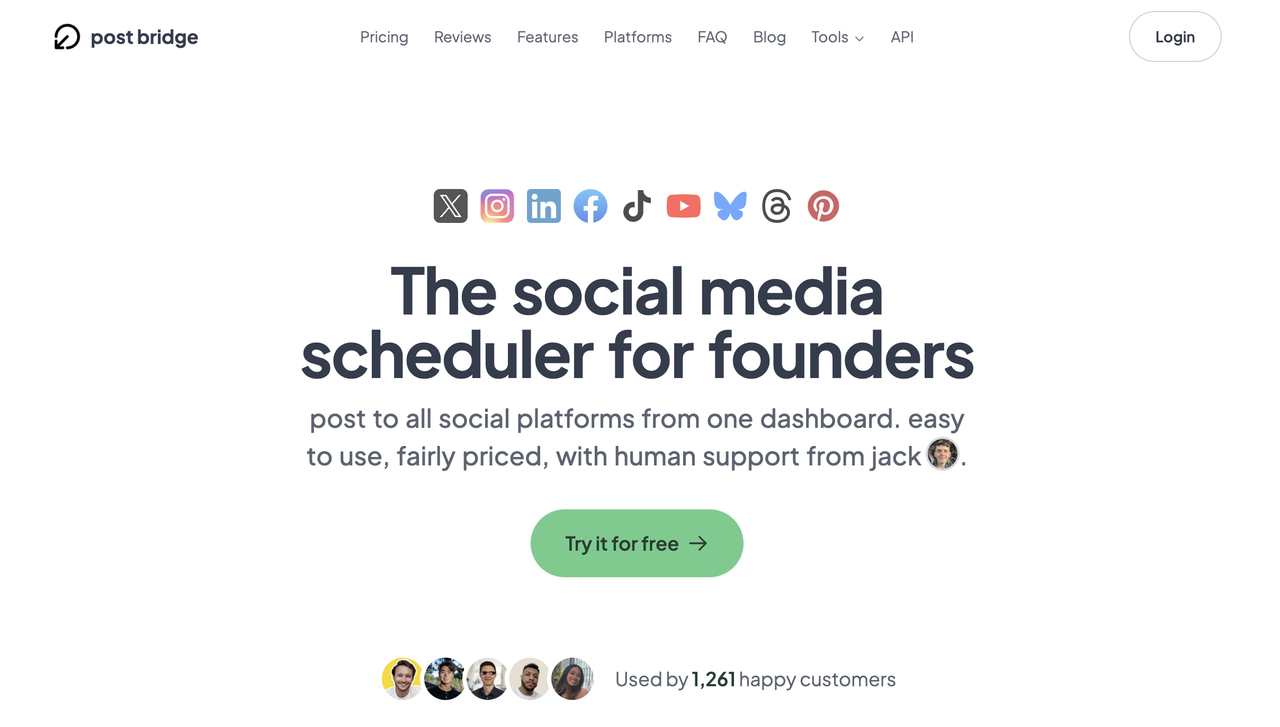
Here's how he did it.
The Problem Everyone Had
Here's the thing about good business ideas: they start with a problem you actually care about solving.
He had already built Curiosity Quench, an app designed to help people stop scrolling on their phones and do their hobbies instead. It hit 100,000 users. But to grow it, Jack needed to post consistently on social media.
The catch? Every time he went to Instagram or TikTok to post, he got sucked into the endless scroll. He'd sit there for 30 minutes just to upload one video. Then he'd have to do it again for LinkedIn. Then X. Then Facebook. Then YouTube.
That's when it hit him: what if there was a tool so simple, so lightweight, that you could upload once and post everywhere without ever actually opening those apps?
The Marketing Strategy: Building an Audience Before the Product Most SaaS founders build a product first, then figure out how to get customers second.
Jack did the opposite.
Before he ever launched Postbridge, he had already built a massive audience of people who trusted him. How? By documenting his entire journey to building apps—the wins, the losses, the failures, the breakthroughs.
He posted on X (Twitter). Every single day. Not salesy posts. Not "growth hacking tips." Real posts about what he was doing, what he was learning, what he messed up.
On X, Jack built an audience of over 42,000 followers who genuinely cared about what he was doing next. These weren't random followers. These were builders, entrepreneurs, and creators who saw Jack as someone like them, someone grinding it out, figuring it out as he went.
Here's his actual marketing tech stack for growing his apps:
- Postbridge (to schedule content)
- Viral video templates from his Content Studio
- A timeline that might take a year or more
- Grit (doing it even when you don't want to) That's it. No paid ads. No fancy marketing agency. No growth hacking tricks.
The result? 30,000 app downloads in a single month using just one hour of daily marketing—making and posting six videos. So when Jack launched Postbridge in October 2024, he didn't have to do cold outreach or buy expensive ad campaigns. His audience was already there. They already knew him. They already trusted him. They just needed to know he built something for them.
The Content Secret Nobody Talks About
Jack's approach to creating viral content is different from what you see in most business books.
He doesn't make content to go viral. He makes content that provides actual value, and then people naturally share it because it's useful. Here's his framework:
Step 1: Find what's already working.
Don't create in a vacuum. Jack spends time scrolling through his niche, not to get lost, but to study what content formats are already resonating with his target audience. He saves videos that are already performing well.
Step 2: Iterate dozens of times.
It usually takes 30 to 100 iterations before you find a format that consistently gets views. Most people quit after post number five. Jack doesn't. He's made roughly 1,000 videos to generate 300+ million views.
Step 3: Make it valuable, not salesy.
Here's where most founders mess up. They start posting and immediately make it about their product. Jack does the opposite.
His content about Postbridge isn't "Buy my tool!" It's "Here's how to grow your app with organic content." The tool is just the vehicle for solving the actual problem.
Step 4: Use clear calls to action.
Once you have someone's attention, direct them clearly. Jack uses pinned comments with links, captions that tell people what to do next, and honest mentions of his product.
Why Fair Pricing Became His Secret Weapon
The social media scheduling market is crowded. Buffer is doing $20 million/year. Sprout Social is doing $385+ million/year. They have teams of 80–1,000 people. Jack walked in with pricing that felt almost insulting to the competition: $9/month for his entry plan.
As of January 2026, Postbridge is now priced at $29/month But here's why that worked:
Most social media creators aren't agencies. They're solo founders. They're creators. They're small teams. They don't need enterprise features. They need to post to 5–8 platforms without going insane, and they don't want to spend $100/month for that privilege.
Buffer thought they could charge based on what big companies would pay. Jack thought about what a real creator could actually afford.
The Pro plan? $27/month for unlimited accounts (now adjusted to $49/month). Compare that to Buffer at $50–100/month, and you suddenly understand why creators started flocking to Postbridge. But pricing is just one piece. The real secret was doing it sustainably. Jack builds for one person, which means he doesn't need massive teams, complex infrastructure, or enterprise sales teams. His margins are enormous because he didn't spend $10 million building unnecessary features that nobody asked for.
He's literally shipping new features in 3 hours to 3 days. The big guys take 3 months.
.png&w=3840&q=75)
Please sign in to continue reading
We do this to make sure real humans read our stuff, not bots.