Panic Attack App, $83k MRR With Zero Investors or Employees: Inside Rootd's Marketing Strategy

$83k+
Revenue/mo
Business Type
SaaS
Monetization
Subscription
Founded
2017
Most successful startups have a founding story that sounds like a business school case study. Rootd's is different. It starts with a panic attack in a university dorm room. And it ends with over 4 million downloads, $1M+ in revenue, and a solo founder who built the whole thing herself.
Here's exactly how she did it.
The Origin Story
Ania Wysocka was in her final year of an International Relations degree, dreaming of working for the United Nations, when panic attacks started hitting her out of nowhere.
Her first instinct? Grab her phone and find an app to help.
There wasn't one.
She was far from home, broke on student loans, had no family doctor, and felt completely alone. So she did what every good founder eventually does, she started obsessively researching the problem herself. She spoke to counsellors, read everything she could find, and tried to make sense of what her body and mind were going through.
Meanwhile, she had a quiet side hobby: graphic design. Over time, that hobby grew into freelance work, and then into a full-time job at a digital agency after graduation.
But the itch to build that app never left.
A couple of years after her first panic attack, Ania sat down and sketched her first wireframes for what would become Rootd.
The best products are often built by the person who needed them first. Ania wasn't guessing at what users wanted, she was the user.
The Early Days
Ania couldn't code. Let's get that out of the way.
When she had her wireframes ready, she walked into an agency and got a quote: $40,000. She didn't have $40,000. So she got creative and found a student developer to build the first version for far less.
That early scrappy pattern, find someone skilled, pay them what you can, get the thing shipped, became a template she'd use over and over again. Rootd was built through piecemeal contracting, project by project, whenever something new needed to be built.
She launched Rootd in 2017 under her company, Simply Rooted Media.
Early downloads were slow. The first version was basic. But the reviews that started coming in were emotional. People were writing about how the app helped them through a panic attack at 2am when no one else was there.
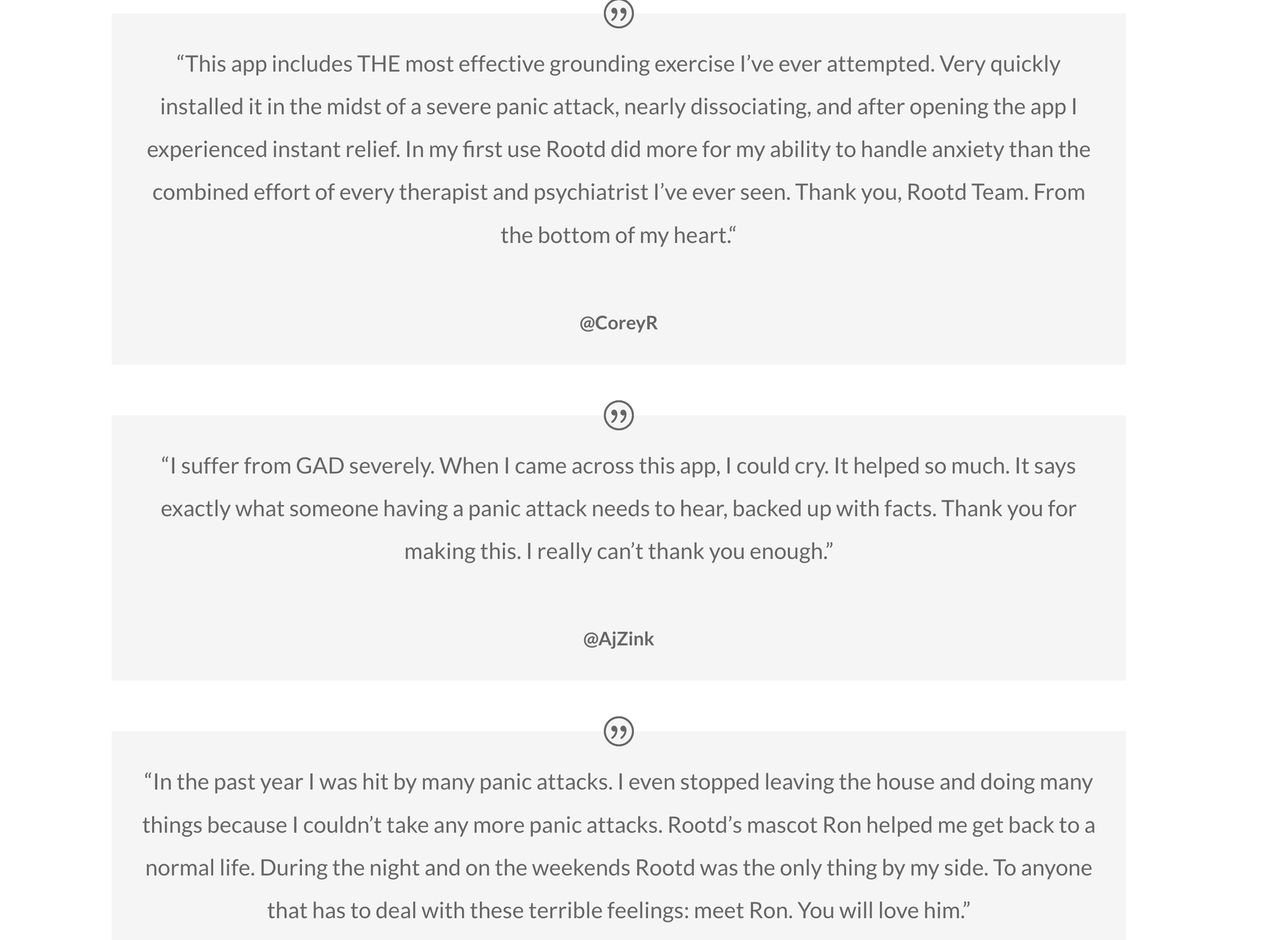
That feedback told Ania everything she needed to know: the problem was real, the product worked, and people were desperate for it.
.png&w=3840&q=75)
The Freemium Trap
For a long time, Rootd was mostly free.
Ania's logic made total sense emotionally: if someone is having a panic attack, I don't want to interrupt them with a paywall. That felt right. It felt kind. And it was killing her revenue.
Then she made one small change.
She moved the paywall to the onboarding flow, the moment right when a new user first opens the app, instead of locking content somewhere deep inside.
The result?
Revenue increased by over 6x in a single month.
That's not a typo. Six times. In one month.
The lesson is that friction placed at the wrong spot in your product quietly destroys your business. Users who saw the paywall during onboarding understood what they were getting. They made a conscious decision. They didn't feel interrupted mid-panic attack, they felt like they were investing in something that would help them.
One tweak. Six times the revenue.
Please sign in to continue reading
We do this to make sure real humans read our stuff, not bots.