$0 to $11M in 18 Months: The Tabs Chocolate TikTok Marketing Blueprint

$611K
Revenue/mo
Business Type
E-commerce
Monetization
One-time Purchase
Founded
2021
Getting Started
It's December 2021. A 20-year-old college kid named Oliver Brocato is scrolling through TikTok in his dorm room when he stumbles across a video that changes his life. Some unknown woman is reviewing a "sex chocolate"—a product designed to boost intimacy. The video has millions of views and thousands of comments. But here's the wild part: the product doesn't even have a website. No marketing. No brand. Nothing.
Oliver's brain lights up. He sees the gap in the market. He knows how to build online brands. He's been doing it since age 14.
So he decides to do something crazy: he'll create a premium version of this product. A high-end aphrodisiac chocolate for couples. Within 18 months, his company, Tabs Chocolate, would hit $11 million in revenue.
Here's how a college kid with zero connections, zero investors, and zero paid advertising pulled off one of the most impressive marketing feats in e-commerce.
The Origin Story
Oliver's entrepreneurial journey didn't start with chocolate. It started with fidget spinners.
When Oliver was 14, the fidget spinner craze was everywhere. Every kid in school wanted one. So Oliver convinced his grandpa to lend him $500. He bought a 3D printer and some skateboard bearings. He made his own fidget spinners and sold them online.
Etsy was his goldmine. His listings became some of the most popular on the platform. Suddenly, this 14-year-old was making real money.
When the fidget spinner trend died, Oliver didn't sit around waiting for the next big thing. He started a social media management company running Instagram accounts for local shops. Then he launched a small Facebook and Instagram advertising agency.
By age 18, Oliver was hired to work on a VC-backed TikTok influencer app (funded by Alexis Ohanian, the co-founder of Reddit). His job was to streamline how influencers collaborated with brands. The app shot up to #4 in the social networking section of the App Store—sitting just below Facebook, Instagram, and WhatsApp. This was a team of six competing against multibillion-dollar companies.
Oliver's superpower wasn't coding or design. It was understanding how TikTok worked. He understood influencers. He understood viral content. He understood that you could make products spread on TikTok without spending a dime on paid ads.
That knowledge would become the foundation of Tabs Chocolate.
The Birth of a Category (Or: Why Traditional Ads Don't Work for This Product) When Oliver saw that viral TikTok video of someone reviewing sex chocolate, he knew he had to act. He teamed up with his friend Jake Lewin (another University of Michigan student), and together they decided to build something better.
But they faced a massive problem: their product couldn't be advertised on traditional platforms.
Facebook? Banned sex-related products. Instagram? Same story. Google? Absolutely not. TikTok had restrictions too, but influencers could post almost anything they wanted. The algorithm was fuzzy enough that creators could slip through the cracks.
So Oliver and Jake had no choice but to go all-in on influencer marketing. It wasn't a choice between paid ads and influencers—it was influencers or nothing.
Here's the thing though: constraints breed genius.
Because they couldn't run Facebook ads or Google ads, they had to build something way more creative. They had to build a system. They had to turn content creators into a distributed network of mini-marketers. And that system became their unfair advantage.
A Masterclass in Design Thinking
Before Tabs could go viral, the product itself had to be perfect.
Oliver and Jake spent over a year perfecting it. They sourced premium, natural ingredients: Epimedium (a libido booster), Maca Root (for energy and endurance), and Kanna (for stress relief). They mixed these into 60% cocoa dark chocolate (which naturally contains mood-elevating compounds like phenylethylamine).
But the product itself wasn't the only thing designed for virality. Everything was engineered for couples and for TikTok.
The packaging was sleek and luxury—black and gold. No embarrassment factor. You could gift this to your partner without shame. Each box contained exactly three chocolate squares. Each square broke perfectly in half. One piece for you. One piece for your partner.
Heres's a look:
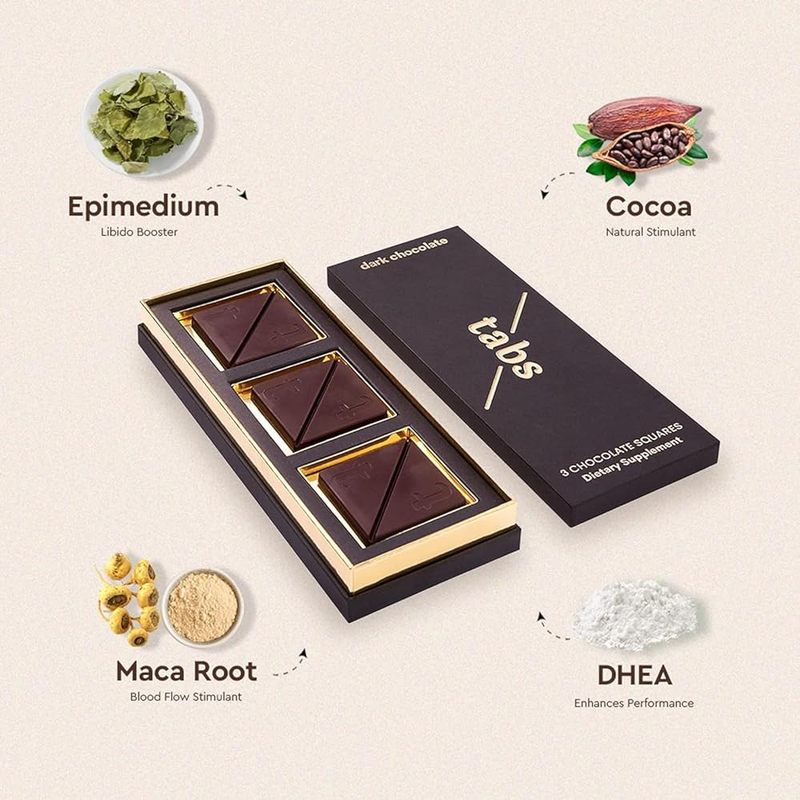
There was something beautiful about this visual metaphor: breaking, biting, and banging together (their slogan was literally "Break. Bite. Bang.")
The price point was $30-$39 per box. Premium pricing. This wasn't cheap chocolate. It was a luxury product for couples who wanted to invest in their relationship.
This detail matters. Because it meant the people buying Tabs weren't just looking for a cheap buzz. They were willing to pay for quality. They were invested in the experience.
.png&w=3840&q=75)
The Marketing Strategy That Changed Everything
Here's where it gets interesting.
Most brands want to work with big influencers. The ones with millions of followers. The assumption is simple: more followers = more reach = more sales.
Oliver flipped that on its head.
Instead of finding one influencer with 1 million followers, he decided to hire dozens of micro-influencers with 50,000 to 200,000 followers each. He'd pay them $500 to $3,000 per month to post one video per day—minimum. At peak, he had 45 creators all running their own Tabs accounts with names like @tabschocolateyy, @thechocolatez, @tabs_chocolates.
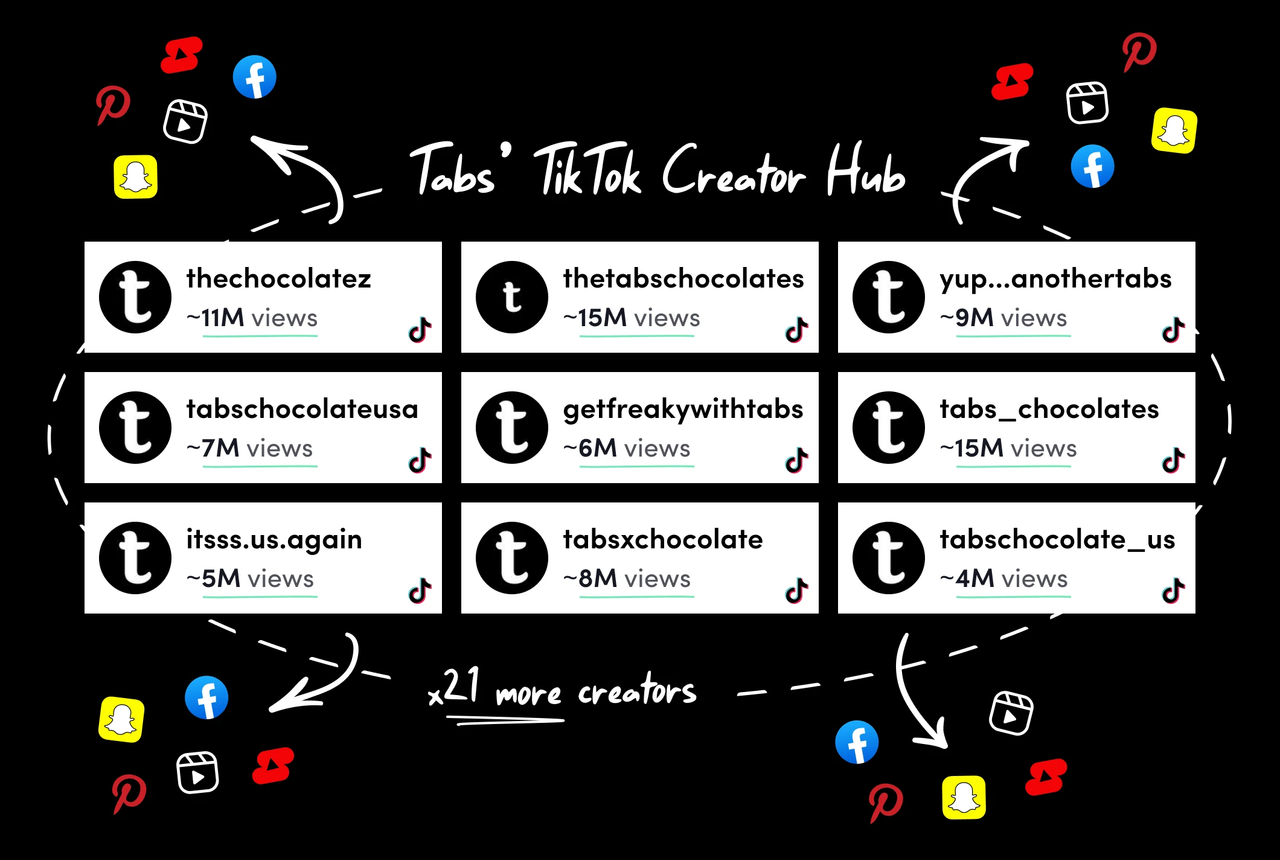 source: marketing examples
Each creator was told exactly how to structure their content:
Video 1: Make it flashy. Hook the viewer immediately. This video needs to go viral and grab attention.
Videos 2-3: These are the conversion killers. These videos actually talk about the product and sell it.
Videos 4+: Respond to comments from the viral video with new content.
The magic insight? The sales didn't come from the first viral video. They came from videos 2, 3, and 4. The first video was just the bait. Videos 2 and 3 were the actual close.
This is important. Most brands obsess over one viral video. Oliver understood that virality is just the opening. The conversion happens in the boring follow-up videos.
The creators who performed best got bumped up to affiliates. Instead of just a monthly fee, they'd earn a 20-25% commission on every sale they drove. It became a performance-based partnership. Suddenly, every creator had skin in the game.
And here's the cost advantage: Oliver wasn't paying for influencer names. He was paying for their scale. A creator with 100,000 followers might get paid $1,000-$3,000 per month. Compare that to a mega-influencer with 1 million followers asking for $50,000+ per post. The math was obvious.
Please sign in to continue reading
We do this to make sure real humans read our stuff, not bots.